For years, the meetings and events industry has been evolving.
Better registration. Better sourcing. Better attendee experiences. Better reporting. More integrations. More automation. Each generation of technology has made the existing experience better. But what happens when the experience itself changes?
Evolution makes the existing experience better. Revolution creates a fundamentally different experience.
That distinction has been on my mind as the industry gathers around the conversation of meeting evolution versus revolution. I believe we have reached the revolution.
From software that helps you work to software that does the work
For decades, meeting technology has largely digitized what people were already doing.
We replaced paper with software. Emails with workflows. Spreadsheets with databases. Phone calls with online sourcing. Manual reports with dashboards. All important improvements. But underneath the technology, people were still doing much of the same work.
They searched. They sourced. They compared. They reconciled. They chased responses. They moved information between systems. They checked policies. They built reports. They followed up with suppliers.
AI — and particularly agentic AI — changes that equation.
Instead of asking, “How can technology make this task easier?” we can finally ask: “Why does a person need to perform this task at all?”
That is the beginning of a revolution.
What does a meeting revolution actually look like?
A revolution isn’t another feature. It changes what is possible.
Less work. Entire manual processes disappear rather than becoming incrementally faster.
Lower costs. Automation changes the economics of meeting management, allowing organizations to manage far more activity without adding equivalent resources.
Greater access. Sophisticated meeting management no longer needs to be reserved for the largest meetings, biggest budgets, or organizations with dedicated planning teams.
More control. Spend, suppliers, travel, attendees, compliance, and logistics that once lived across different people and systems can become visible and manageable.
New capabilities. Technology can evaluate thousands of variables, identify patterns, recommend actions, and coordinate workflows at a scale no individual planner could reasonably replicate.
And perhaps most importantly:
A different role for humans.
The future isn’t about eliminating the expertise of meeting professionals.
It’s about elevating it.
People should spend less time searching, entering data, chasing responses, reconciling spreadsheets, and moving information between systems — and more time deciding, advising, creating, negotiating, and handling the moments where human judgment matters most.
Imagine starting with the outcome
Imagine telling an AI agent:
“I need to bring 75 people from these 12 cities together in November. Find the destination that balances airfare, hotel costs, travel time, and our company policies.”
And it does.
It identifies where to meet. Sources the venues. Collects bids. Normalizes the responses. Calculates costs. Flags policy issues. Recommends options. Builds the budget. Coordinates travel. Tracks attendees. Reconciles spend.
The human hasn’t disappeared. The human has moved up the value chain. Instead of spending hours assembling information, the meeting professional is making decisions. That’s fundamentally different from making today’s sourcing process 20% faster.
That’s revolution.
Meetings become infrastructure
There is an even bigger change underway.
Organizations hold in-person meetings every day: internal meetings, sales meetings, trainings, conferences, customer events, candidate interviews, advisory boards, incentive programs, field meetings and thousands of smaller gatherings.
Every one creates spend, travel, logistics, data and often compliance requirements. Yet much of that activity is still managed by people working across disconnected systems, suppliers, spreadsheets, emails and processes.
The meeting revolution changes that.
Instead of thinking about meeting technology as software used by planners to manage individual events, we can think about it as enterprise infrastructure for every time an organization brings people together.
One platform can understand the meeting. AI agents can orchestrate the work. Enterprise systems can provide the policies, employee information, expense data and approvals. Marketplaces can connect demand directly to hotels, venues, restaurants and other suppliers. Humans can provide expertise, judgment and service when it matters. And organizations can finally see and manage the whole.
Why we rebuilt Groupize
This is the future we have been building toward.
Over the past year, we made a multimillion-dollar investment to transform Groupize across our product, AI capabilities, security, integrations, team and commercial model.
We took everything we learned over 13 years — every customer conversation, implementation, workflow, feature request and limitation — and asked ourselves what we would build if we could rethink meeting management for the agentic era.
The answer wasn’t simply a better version of what already existed.
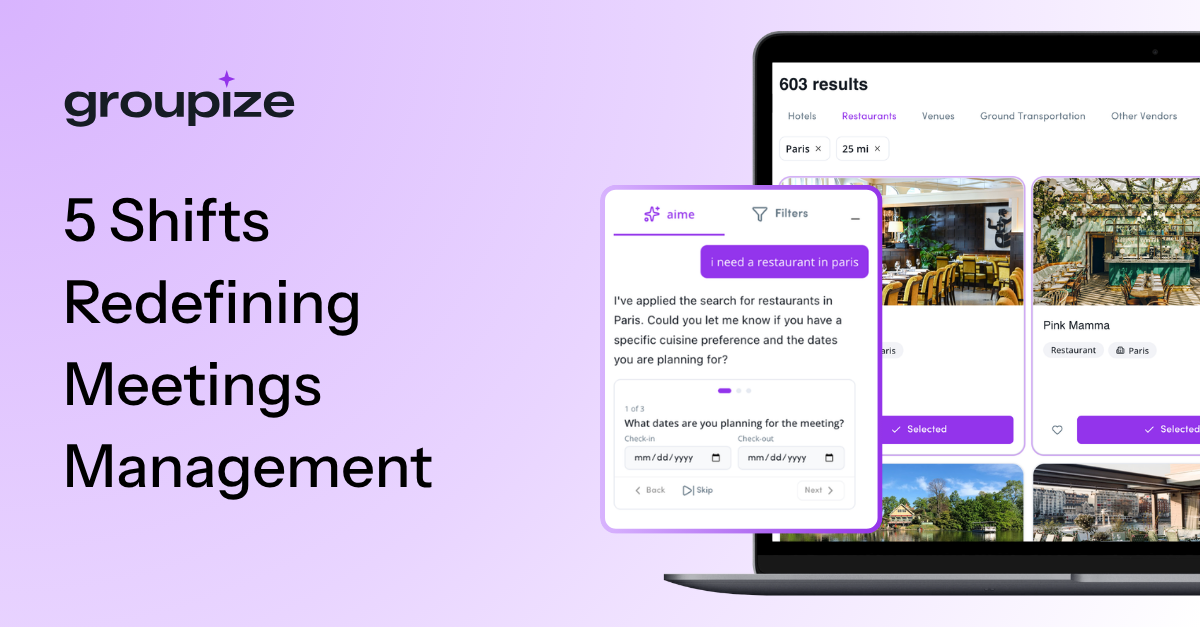
It became aime™, our agentic platform for meetings, events and group travel.
We built specialized agents to perform work that previously required people moving between systems and processes.
We connected the platform deeply into SAP Concur, including Travel, Expense and Request, and began enabling agent-to-agent workflows with SAP Joule.
We expanded beyond hotels into a broader marketplace of venues, restaurants and suppliers.
We built for global organizations, supporting 74 languages, currencies and localized experiences.
We introduced AI-powered capabilities such as Where to Meet, which can evaluate attendee origins, travel costs and other factors to help determine where a meeting should happen.
We reimagined guest travel, registration, budgeting, reconciliation, reporting and sourcing.
And we changed our commercial models because the economics of meeting technology should evolve along with the technology itself.
These aren’t endpoints. They are building blocks for something much larger.
From managing meetings to managing the meeting economy
The opportunity ahead isn’t simply to build better meeting software. It’s to create a new operating model for how organizations bring people together.
One where every meeting can be managed — not just the largest ones. Where organizations can understand their total meeting spend. Where policy and compliance can be embedded instead of checked afterward. Where employees can get sophisticated support without becoming meeting planners. Where suppliers can connect more efficiently with demand. Where AI handles repetitive work and people provide judgment and expertise. And where meeting professionals become more strategic, not less important.
For years, our industry has asked how technology could improve meetings. Perhaps the more interesting question now is:
If AI can fundamentally change how meetings are planned, purchased, governed and managed, why would we preserve the old way of doing it at all?
Evolution got us here.
Now comes the meeting revolution.