Contracts have always been the foundation of successful meetings and events. They define expectations, protect organizations from financial risk, and establish accountability with partners. Yet, while the meetings landscape has changed dramatically in recent years, many contracts look much the same as they did a decade ago.
Economic volatility, political shifts, changing travel patterns, and rising costs have all introduced new challenges. Security needs are higher, sustainability is no longer optional, and data privacy is governed by an evolving web of regulations. At the same time, artificial intelligence is transforming how planners source venues, manage logistics, and review agreements—while also raising new questions about transparency and compliance.
This environment requires a different approach. Contracts can no longer be static or reactive; they must be adaptable, data-driven, and supported by technology.
The Pressure of Rising Costs and Shrinking Budgets
Food and beverage pricing has consistently increased faster than inflation, and service fees and add-on charges continue to multiply. Traditional negotiation strategies often leave organizations exposed to unpredictable costs. The solution lies not only in tightening clauses but in bringing better data to the table. With sourcing solutions like groupize.ai/ and The Vendry by Groupize, planners can compare pricing across a global marketplace of more than one million venues, ensuring terms reflect true market value.
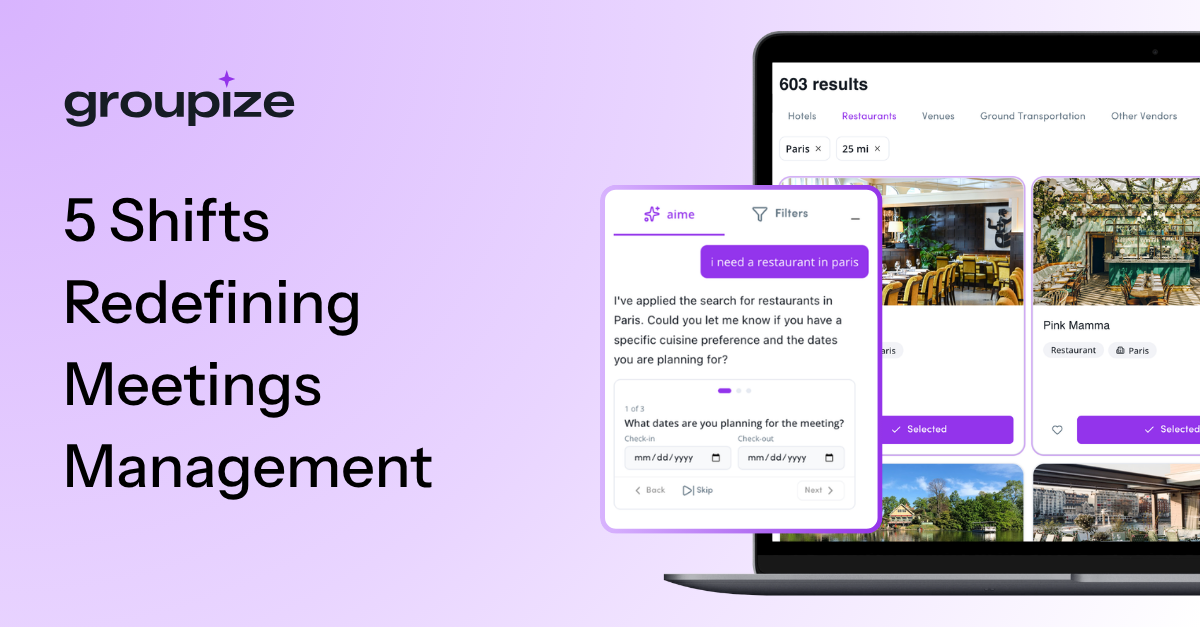
Room blocks require similar scrutiny. Attendance is less predictable than it once was, with many organizations facing lower numbers due to budget restrictions or shifting travel behavior. Conservative commitments and adjustment clauses are essential, but so too is forecasting. groupize.ai/ Meetings Management leverages historical trends and predictive analytics to model likely demand, helping organizations avoid attrition penalties without under-serving attendees.
The Growing Importance of Privacy and Security
Data has become one of the most sensitive aspects of event planning. With attendees often crossing multiple borders, planners must navigate a patchwork of state, national, and international regulations. Compliance is a moving target, and the risks of mishandling information are greater than ever.
The most effective strategies focus on minimizing unnecessary data collection, ensuring transparency around usage, and setting clear retention timelines. Technology supports this by automating compliance checks, securely managing sensitive records, and flagging risks that human reviewers might miss. AI-driven safeguards embedded in groupize.ai/ Meetings Management help organizations meet regulatory requirements while maintaining attendee trust.
Security extends beyond data. Today’s climate demands stronger on-site protections, from VIP protocols to contingency planning for disruptions. Contracts should specify roles, costs, and responsibilities clearly. Here, technology can assess risk profiles and surface requirements before negotiations even begin.
Sustainability With Accountability
Sustainability has moved from aspiration to obligation. Increasingly, contracts call for measurable commitments, such as reporting carbon usage or demonstrating year-over-year improvements. Some even include financial penalties for failing to meet agreed-upon metrics.
To address this, planners need reliable tracking and reporting mechanisms. groupize.ai/ Registration & Logistics and sourcing tools provide the data backbone, consolidating information on travel, venue, and vendor choices to quantify environmental impact. With accurate reporting, organizations can not only meet contractual obligations but also strengthen their reputation with stakeholders.
Policy Shifts and Global Uncertainty
Government tariffs, shifts in funding, immigration restrictions, and new state-level laws all contribute to unpredictability. Events scheduled years in advance must account for conditions that may look very different when the program takes place. Force majeure clauses need to reflect this reality, covering not just natural disasters but also regulatory and political disruptions.
Platforms like groupize.ai/ Guest & Group Travel make these challenges more manageable by monitoring travel restrictions, visa requirements, and regional policies that could affect attendee participation. When contracts are backed by real-time intelligence, organizations can adapt more effectively to external shocks.
The Question of AI in Contracts
While AI is providing unprecedented efficiency in sourcing, registration, and contract review, it is also creating new legal considerations. Some organizations are beginning to restrict how AI can be used by vendors or event partners, often driven by concerns about data handling. Contracts may now need to specify when AI can be applied, what data it has access to, and how outputs are validated.
Planners should be proactive in addressing these provisions, ensuring their own use of AI is transparent while asking the same of suppliers. With groupize.ai/, AI is not a black box but a tool built for transparency, compliance, and efficiency, making it easier to meet the expectations of increasingly cautious stakeholders.
More Stakeholders, More Scrutiny
Another shift since the pandemic is the sheer number of stakeholders involved in reviewing event contracts. Legal, finance, compliance, and executive teams are more engaged than ever, and while this strengthens accountability, it also slows down negotiations. Conflicting priorities or unrealistic expectations from non-specialists can make it difficult to finalize agreements in a timely way.
Centralizing the process is critical. groupize.ai/ Meetings Management provides a single platform where all stakeholders can access the same documents, track revisions, and collaborate in real time. This prevents version-control issues, reduces confusion, and accelerates decision-making.
The Role of Technology in Future-Proofing Contracts
What connects these challenges—cost escalation, privacy and security, sustainability, policy uncertainty, AI restrictions, and stakeholder scrutiny—is complexity. No single planner, legal advisor, or supplier can address them alone. The key is to bring visibility, automation, and predictive insight into the contracting process.
The groupize.ai/ platform was designed to do exactly that. By unifying sourcing, contracting, logistics, travel, and compliance into one system, and embedding AI into the workflows that matter most, it helps organizations negotiate stronger agreements and enforce them with confidence.
Takeaways
Contracts are no longer just legal documents filed away after signatures, they are dynamic instruments that shape financial outcomes, attendee experiences, and organizational risk. In today’s environment, they must be data-driven, transparent, and adaptable.
By rethinking how contracts are written and supported, and by leveraging technology like groupize.ai/, organizations can move beyond survival mode. They can protect budgets, safeguard attendees, and build meetings and events that are resilient to whatever uncertainties the future brings.